— Origin Dossier —
No. 01
Lakadong Turmeric.
From the Jaintia Hills of Meghalaya.
Region: Lakadong, Jaintia Hills · State: Meghalaya · Geographical Indication tag

Curcumin
10%+
The Lakadong cultivar assays between 7% and 12%. We pack only lots testing 10% or above — three to five times ordinary commercial turmeric, which sits closer to 2 – 3%.
Harvest
November – February
A single annual harvest after 8 – 10 months in the ground. Rhizomes are washed, boiled, peeled and sun-dried for up to 15 days. Eight kilos of fresh rhizome yield one kilo of powder.
Soil & Climate
1,000 – 1,400 metres
Grown on red-loam slopes washed by the Khasi-Jaintia monsoon. Cool nights, long mist, and forest-edge shade.
In the kitchen
A pinch
Bloom in warm oil or ghee before adding aromatics — the colour deepens, the bitterness softens, and the room begins to smell of root and earth.
Lakadong is not a brand name. It is a place — a cluster of villages in the West Jaintia Hills where Pnar farmers have grown this cultivar for generations.
Lakadong
What we pack
- 10%+ curcumin, tested per lot
- Colour reads almost orange raw
- Warm, faintly bitter, woody aroma
- Geographical Indication tagged
Ordinary turmeric
The supermarket packet
- 2 – 3% curcumin
- Pale, flat yellow
- Aroma largely polished out
- Country of origin at best
Why the address matters
Move the rhizome a few hundred kilometres and the curcumin falls, the colour pales, the aroma flattens. That is the whole reason the Geographical Indication exists — the variety cannot be faithfully reproduced outside this terrain.
A note: we describe Lakadong by what it is — colour, aroma, curcumin — not by what it cures. Indian kitchens have used turmeric for generations. That is claim enough.
Visit the Lakadong product page →
— Origin Dossier —
No. 02
TGSEB Black Pepper.
The largest, latest-picked Tellicherry berry.
Region: Malabar Coast · State: Kerala · Grade: Tellicherry Garbled Special Extra Bold
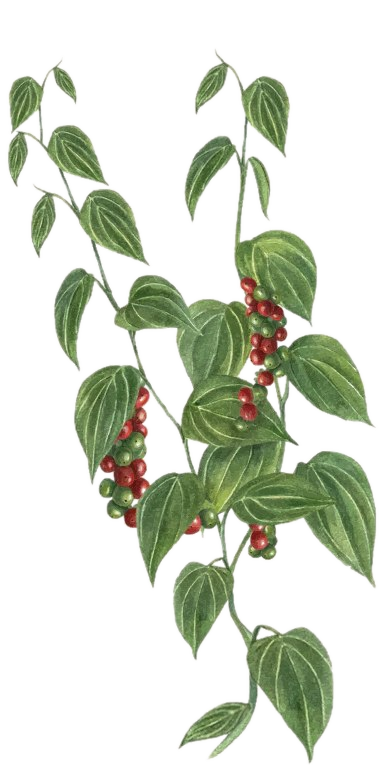
Berry size
4.75 millimetres +
TGSEB is the top sieve grade of Indian black pepper. Only the largest, fully matured berries qualify — roughly the top 10% of the harvest.
Piperine
5 – 6%
A high piperine reading lifts both the heat and the volatile aroma. TGSEB is prized in the spice trade for its long, slow warmth.
Tellicherry, decoded
T·G·S·E·B
Tellicherry · Garbled (sorted clean) · Special · Extra · Bold. The grading walks up the sieve, one millimetre at a time.
In the kitchen
Crack fresh
The first note is sharp and citrus-bright; the warmth arrives a breath later and settles at the back of the palate. A finishing pepper, not a frying pepper.
Piper nigrum is a vine. It climbs areca, jackfruit and silver oak on the Malabar Coast, and has done for two thousand years. Berries take eight to nine months to mature — and one spike carries several stages of ripeness at once.
T · G · S · E · B, decoded
Tellicherry — the northern Malabar coast, now Thalassery. Garbled — sorted clean of stalk and dust. Special Extra Bold — the size class, walking up the sieve one millimetre at a time.
Only berries above 4.75 millimetres survive the final cut — roughly the top 10% of the harvest.
Tellicherry became a grading word because the region let berries hang longer, picked them later, and sorted them harder than other ports. A denser, heavier berry carries more piperine and more volatile oil — the slow warmth good pepper is remembered for.
A note: size on its own is not quality. We grade by sieve and by aroma — a bold berry that has lost its perfume is no better than a small one.
Visit the Black Pepper product page →
— Origin Dossier —
No. 03
Kashmir Saffron.
Mongra grade, from the karewas of Pampore.
Region: Pampore, Pulwama · State: Jammu and Kashmir · Geographical Indication tag

Grade
Mongra
Mongra is not a place — it is the cut. Only the deep-red stigma tips are kept; the pale yellow style, which carries almost no colour or aroma, is discarded. It is the reason the price is what it is.
Harvest
October – November
A three-week window, once a year. Flowers are picked before the sun is high and the stigmas separated by hand the same day, because a crocus left open loses its aroma quickly.
Yield
150,000+
Each flower carries exactly three stigmas. It takes roughly 150,000 – 200,000 flowers to make a single kilo. That arithmetic — not scarcity marketing — is why saffron is weighed in grams.
In the kitchen
A few strands
Bloom in warm milk or water before adding — never dropped dry into a hot pan. Give it ten minutes and the liquid turns amber before the food ever sees it.
The karewas of Pampore are raised plateaus of clay and gravel outside Srinagar — poor soil, cold nights, a short autumn. Crocus sativus does not mind. It flowers for three weeks, and for those three weeks the fields are picked entirely by hand.
Mongra
What we sell
- Only the deep-red stigma tips
- Carries the crocin, picrocrocin and safranal
- Weighs less, so costs more per gram
- You use fewer strands
Lachha
The commoner grade
- Red stigma plus the pale style
- The style carries almost no colour or aroma
- Cheaper per gram — heavier with filler
- You use more for the same result
Mongra is a cut, not a place
It is written as though it were a village more often than not. It is not. It describes what was kept and what was thrown away.
Kashmiri saffron received its Geographical Indication in 2020, covering the Pampore, Budgam, Kishtwar and Srinagar belt. The tag exists because the market has a long history of adulteration — dyed maize silk, safflower, coloured thread sold by the gram. An address is the simplest defence a buyer has.
A note: we describe saffron by colour, aroma and grade — not by what it treats. Kashmiri kitchens have used it in pulao, kahwa and kheer for centuries. That is claim enough.
Visit the Kashmir Saffron product page →
— Origin Dossier —
No. 04
Seremna Black Cardamom.
From Hee Gaon, in the hills of West Sikkim.
Region: Hee Gaon, West Sikkim · State: Sikkim · Sikkim Large Cardamom, Geographical Indication 376 · Wood-fire cured

Species
Amomum subulatum
Large cardamom — a different plant from the small green pod of the Western Ghats. Bigger, darker, ridged, and smoky rather than sweet. Not a substitute for one another.
Harvest
August – September
Flowering starts in March and April; the fruit takes about four months to mature, and cutting begins in the second week of August, once the seeds in the topmost capsule have turned brown to black. A plant bears from its second year.
Capsule
65 – 70 seeds
Sub-spherical, 2.5 – 3 centimetres long and about 2 centimetres across, dark maroon. A fresh capsule weighs a little over five grams and dries down to roughly one and a quarter — and it carries more seed than other cultivars, which is why the dried pod stays heavy.
In the kitchen
Crush lightly
Crack the pod before it goes into biryani, a dal, or a garam masala. Whole and unbruised it will sit in the pot and give you almost nothing.
Black cardamom is the most misunderstood spice in the Indian pantry, because it shares a name with something it is not.
Black
Amomum subulatum
- Large, ridged, leathery pod
- Resin and warmth
- Slow-cooked, savoury food
- Eastern Himalayas
Green
Elettaria cardamomum
- Small, smooth, pale green
- Floral and sweet
- Desserts and chai
- Western Ghats
Swapping one for the other is not a variation. It is a mistake.
Hee Gaon, 1982. The late Sukh Ram Subba, a grower in this West Sikkim village, spotted one clump behaving differently — bigger capsules, better yield, shrugging off disease. He raised saplings and pressed his neighbours to plant it. By 1985 the valley had taken it up. The name comes from a Limboo word for drooping leaves.
The smoke, corrected
Nearly every description treats the smoke as the point — including, until we read the growers' own filing, ours. The Hee Gaon growers deliberately burn dry wood to keep smoke down, because heavy smoke costs the capsule its colour and aroma. The fire dries; it does not flavour. Taste resin and warmth with a trace of woodsmoke — not a bonfire.
Roughly nine of every ten Seremna pods grown anywhere still come from this one valley.
The thin husk does two things: Seremna cures faster than other large cardamoms, and the calyx — the tail that elsewhere must be trimmed with scissors — falls away by itself. Bigger dried capsules, more seed, no trimming. That is what earns the price, and why the growers' cooperative applied for a Geographical Indication in the name of the village rather than the state.
A note: black cardamom should smell of woodsmoke before you open it. If a pod smells of nothing through the shell, it has been sitting somewhere warm for too long.
Visit the Black Cardamom product page →
— Origin Dossier —
No. 05
Ceylon Cinnamon.
Alba grade, from Galle and Matara in southern Sri Lanka.
Region: Galle & Matara · Country: Sri Lanka · True cinnamon

Coumarin
0.004%
True cinnamon — Cinnamomum verum, the botanical name literally means true. Cassia, the hard red bark sold as cinnamon almost everywhere, carries roughly 0.2 – 1.2%; Germany's Federal Institute for Risk Assessment has measured cassia powder at 1,740 – 7,670 mg/kg. Ceylon sits near 0.004% — on the order of a hundred times less. That gap is the whole argument for Ceylon.
Grade
Alba
The finest of the four Ceylon grades — Alba, Continental, Mexican, Hamburg. Taken from the innermost bark of young shoots and cut to 5-inch sticks, 5 – 9 millimetres across. Alba fetches about twice the price of the coarser grades.
Harvest
Year-round
Hand-peeled from young shoots rather than felled trunks. The bark is stripped, the outer layer scraped away, and the inner bark rolled by hand into quills that telescope as they dry.
In the kitchen
Simmer whole
Ceylon is delicate where cassia is loud. Simmer a whole quill in chai, milk or a dessert syrup; it will crumble under a rolling pin if you prefer it ground fresh.
Most cinnamon is not cinnamon. The hard, dark-red sticks sold as dalchini in most Indian shops are cassia. Ceylon cinnamon is a different tree.
Ceylon
Cinnamomum verum — "true"
- Under 0.1 mm thick
- Pale tan; shatters in the fingers
- A single spiral of fine layers
- Sweet, citrus-bright, layered
Cassia
Sold as dalchini
- Around 1.5 mm thick
- Dark red; survives being dropped
- A double scroll from both edges
- Pungent, hot, dominating
The three-second test
Papery and single-curled, or woody and double-curled. You do not need a laboratory — you need to look at the stick.
Grade is thickness. Ceylon is sorted Alba, Continental, Mexican, Hamburg — finest to coarsest. Alba takes the innermost bark of young shoots, cut to a uniform five inches, and fetches about twice the coarser grades. A peeler who tears the bark downgrades it in a second.
Around Galle and Matara the work is still manual: branches soaked to soften the bark, the rough outer layer scraped away, the inner bark lifted off in sheets by a peeler judging thickness against the bones of their own fingers. The craft passes down within the Salagama and Hakuru communities, and experienced peelers are becoming scarce.
A note: Ceylon cinnamon is the one spice in our catalogue that is not Indian. We say so plainly on the pack. An honest address is worth more than a convenient one.
Visit the Ceylon Cinnamon product page →
— Origin Dossier —
No. 06
Saurashtra Coriander.
A+ grade seed, from the black soil of Saurashtra.
Region: Saurashtra · State: Gujarat · Sun-dried

Grade
A+ / Eagle
Graded on size, uniformity and colour — plump, pale-green to straw seed with the husk intact. Broken or bleached seed has usually lost its oil before it reached the sack.
Harvest
February – March
A rabi crop, sown after the monsoon and cut in late winter. Sun-dried on the threshing floor rather than kiln-dried, which keeps the seed pale and the aroma intact.
Aroma
Citrus & wood
Good coriander should read lemony and faintly sweet, not dusty. That top note is volatile — it is the first thing lost to age, heat and pre-ground packaging.
In the kitchen
Roast, then grind
Dry-roast whole seed for under a minute until it smells warm, then grind. Ground coriander bought loose is usually months past the point where this mattered.
Coriander is the quiet backbone of Indian cooking — the bulk of most masalas, carrying other spices rather than announcing itself.
Which is exactly why it is the spice most often sold stale. Nobody complains about dull coriander. They just cook with more of it.
Good seed
What to look for
- Plump, evenly pale-green to straw
- Husk unbroken
- Smells lemony, faintly sweet
- Sun-dried on the threshing floor
Tired seed
What to avoid
- Broken, bleached or browned
- Split husk — the oil has left
- Smells dusty, or of nothing
- Kiln-dried, which browns it
Gujarat is India's largest coriander-growing state, and Saurashtra grows it on black cotton soil under a dry winter — sown after the monsoon drains, cut in February and March. Once the husk splits the citrus note starts leaving, and no amount of careful storage brings it back.
A note: buy coriander whole and grind what you need. It is the single change that will improve more of your cooking than any other spice upgrade.
Visit the Coriander Seeds product page →
— Origin Dossier —
No. 07
Fennel Seeds.
Parrot grade — the green, sweet fennel of Unjha.
Region: Unjha, Mehsana · State: North Gujarat · Unjha Fennel, Geographical Indication 1290 · Sun-dried

Grade
Parrot
Named for the colour, not a cultivar. Parrot-grade fennel is the bright green, long, plump seed — sweeter and more aromatic than the pale, short, greyish seed that fills most supermarket packs.
Harvest
February – March
Sown between October and November, cut in February and March when the umbels have set but before the seed browns. Picked green and sun-dried, which is what preserves the colour.
Volatile oil
2.20%
Against roughly 1.35% in the Rajasthan crop. Anethole — the compound behind the sweet, anise-like note — makes up the bulk of it. It is volatile and it fades, which is why old fennel tastes faintly of hay and why colour is a reasonable proxy for freshness.
In the kitchen
Chew or temper
Sweet enough to chew plain as mukhwas after a meal, or tempered whole in hot ghee at the start of a dish. Both uses want the same thing: seed that still smells of itself.
Fennel is the one spice in an Indian household that gets eaten on its own. The bowl by the door after dinner, the sugar-coated version at a wedding, the handful pressed on you by a relative — saunf occupies a social role most spices never get near.
Which makes the quality gap unusually visible. Cut green and sun-dried, the seed holds its colour and its anethole. Cut late or force-dried, and it browns.
Parrot grade
The top of the sort
- Bright green, long, plump
- Polished, non-porous surface
- Firm — reads like tiny pebbles
- Sweet, cooling, anise-like
Supermarket fennel
What fills most packs
- Short, greyish, pale
- Dull and faintly dusty
- Brittle or broken
- Tastes faintly of hay
Volatile oil
2.20%
Against roughly 1.35% in the Rajasthan crop.
Crude fibre
19.67%
Against 16.32% in Rajasthan and 15.17% in Haryana.
Ours comes from Unjha, in Mehsana district of North Gujarat — one of the largest spice trading centres in Asia, and the town the Indian fennel trade runs through. Unjha fennel, variyali in Gujarati, has its own Geographical Indication application, filed in June 2024 by the town's Agricultural Produce Market Committee and advertised as accepted in November 2025.
Parrot grade is not a botanical distinction. It is a grader with a good eye and a strict sieve.
A note: if fennel is the thing you reach for after dinner, buy it in small quantities and often. Colour tells you more than any date printed on a pack.
Visit the Fennel Seeds product page →
— Origin Dossier —
No. 08
Vanilla Beans.
18 centimetres and over, from the coffee shade of Chikmagalur.
Region: Chikmagalur · State: Karnataka · Hand-pollinated

Species
Vanilla planifolia
The Bourbon type, and an orchid — the only one grown for food. It climbs, and in Chikmagalur it usually climbs the shade trees planted for coffee.
Pollination
By hand
Outside its native Mexico the flower has no natural pollinator. Every pod is pollinated by hand with a bamboo pick, flower by flower, within hours of opening — the bloom lasts less than a day.
Curing
Six months
Green pods have no smell at all. Roughly six months of killing, sweating, sun-drying and conditioning is what develops vanillin. The aroma is made after the harvest, not before it.
In the kitchen
Split and scrape
Split the pod, scrape the seed into warm milk or cream. Keep the empty pod — buried in a jar of sugar it will keep giving for months.
Vanilla is the second most expensive spice on earth after saffron, and the reason is labour rather than rarity. The vine grows readily enough. It is everything after the flower that costs.
The vine grows readily enough. It is everything after the flower that costs.
- Pollinate by hand, within hours. The flower opens for less than a day and, outside Mexico, has no insect that will pollinate it. Somebody walks the rows each morning with a sliver of bamboo. Miss the window and that flower produces nothing.
- Wait most of a year for the pod to mature on the vine.
- Pick it — and smell nothing. Green vanilla smells of grass. There is no vanillin in it yet.
- Cure for roughly six months — killing, sweating, sun-drying, conditioning. The aroma is made after the harvest, not before it.
Why Chikmagalur
Vanilla needs shade and something to climb. A coffee estate already has both — so the orchid goes up the shade trees planted for the coffee.
Length is the grading standard, and 18 centimetres and over is the premium tier — longer pods generally mean fuller, oilier, better-cured beans.
A note: a good bean should be supple enough to wrap around a finger without snapping. Brittle vanilla has been over-dried, and no amount of soaking brings it back.
Visit the Vanilla Beans product page →
— More Field Notes —


